|
|
||
|---|---|---|
| .. | ||
| component-registry-add-menu.png | ||
| custom-surface-on-skinned-renderer.png | ||
| larger-material-thumbnail-previews.png | ||
| material-editor-create-instance.png | ||
| material-instance-sparse-overrides.png | ||
| mesh-light-component-composition.png | ||
| README.md | ||
| skinned-mesh-renderer-material-slots.png | ||


Renderer, Material, and Component Foundation Evaluation
Date: 2026-07-11
Branch: codex/renderer-material-component-foundation
This record captures implementation evidence for the dedicated skinned renderer, shared Material and Material Instance workflow, registry-driven authoring components, and custom Surface contract. The permanent design contracts live in ADR 0033, ADR 0034, ADR 0035, and ADR 0036. The user workflow lives in the material-system guide.
Live editor evidence
All images below are native Wayland captures from the running editor. The temporary actors and assignments used for visual verification were not saved into the authored scene.
Dedicated skinned renderer and stable material slots
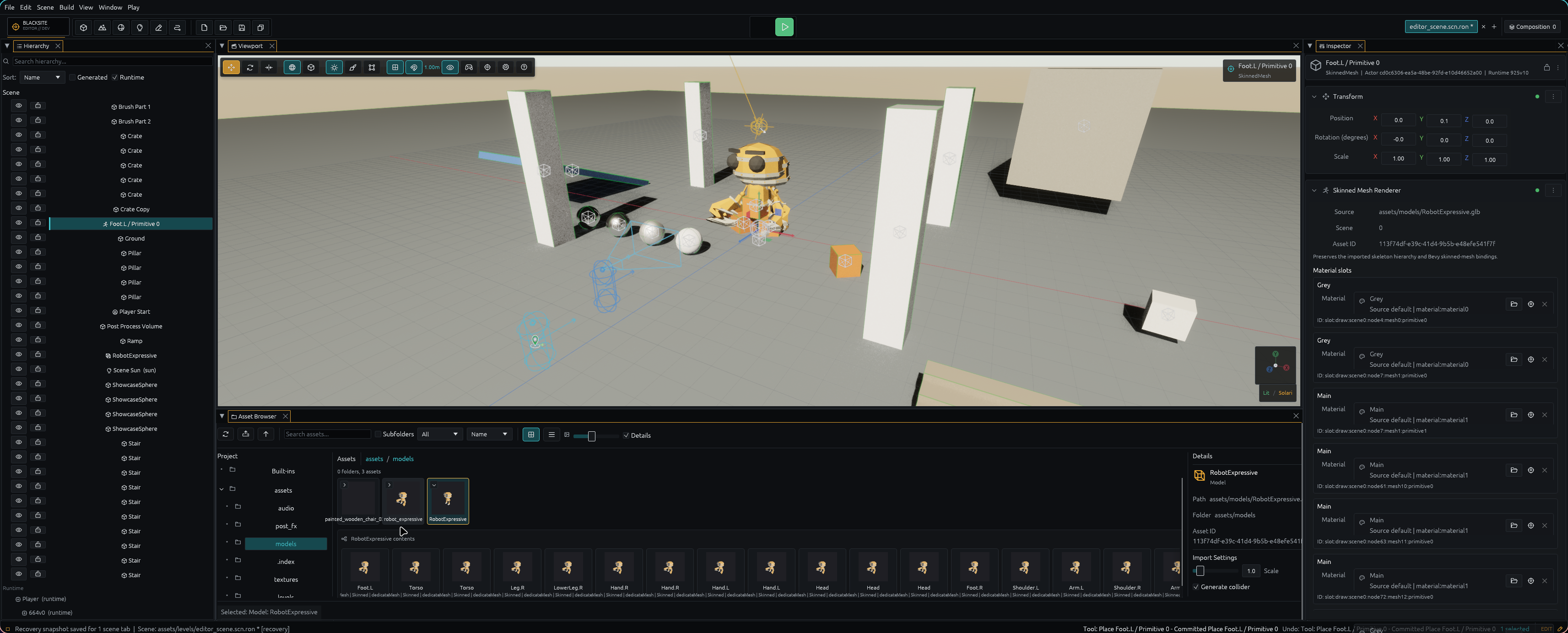
The actor is hydrated through SkinnedMeshRenderer, not StaticMeshRenderer. Its imported
hierarchy remains intact, the configured default Standing clip is sampled in edit mode, and every
draw binding exposes a stable slot ID plus source-material fallback.
Shared custom Surface assigned through a Material Instance
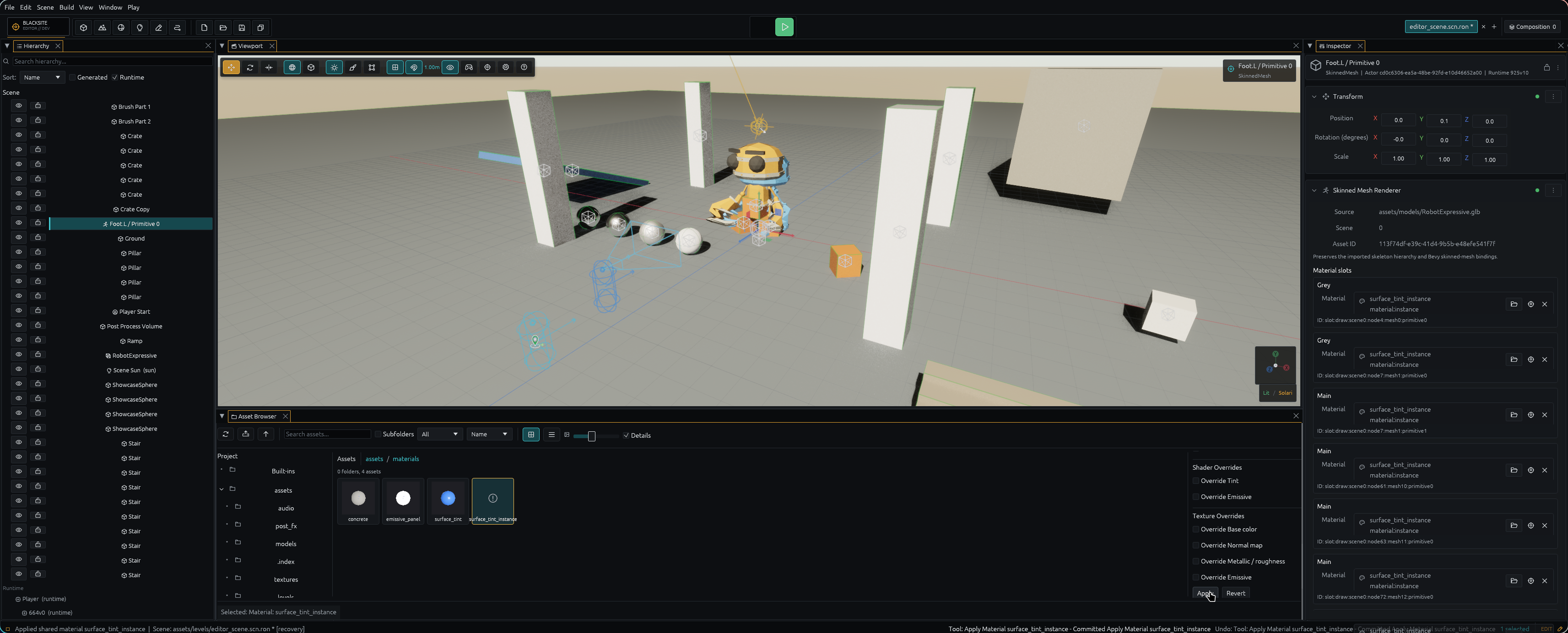
Applying surface_tint_instance updates the existing hydrated draw bindings in place. The visible
blue Surface evaluation does not respawn the hierarchy or reset the sampled pose.
Sparse Material Instance authoring
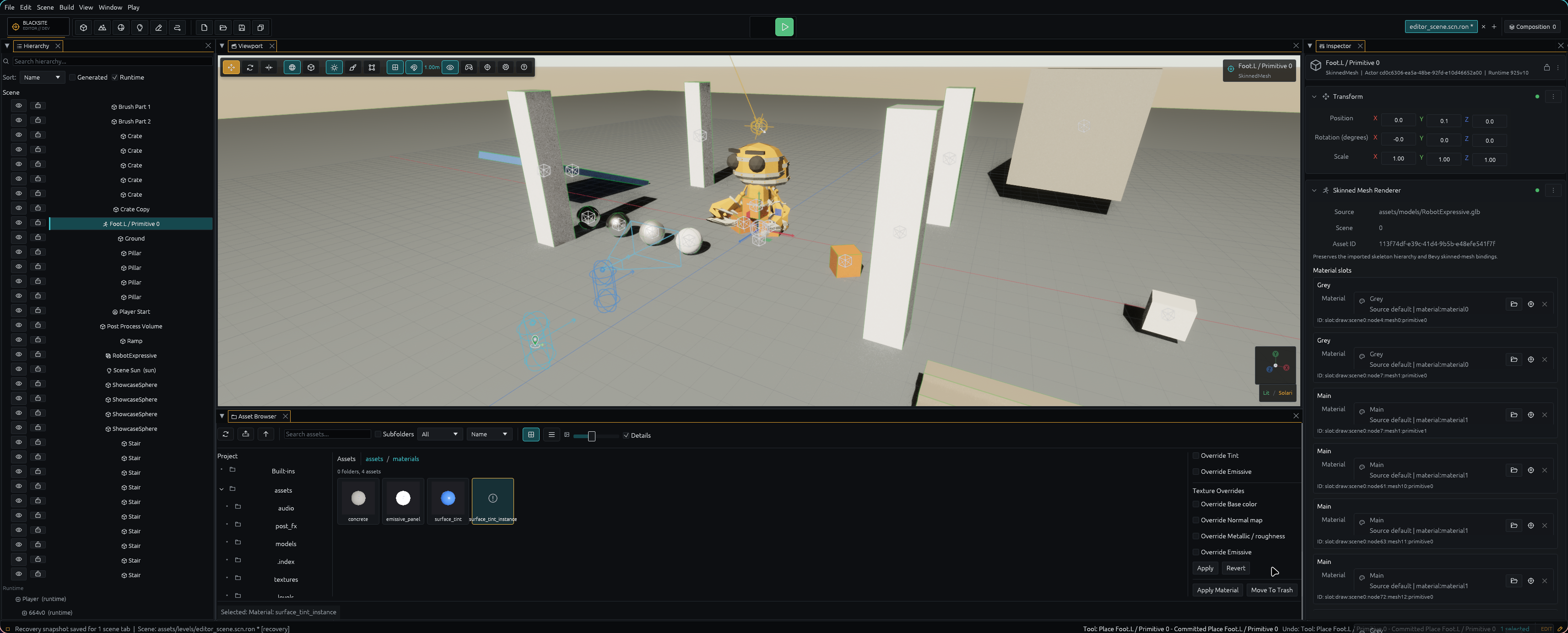
Instances reference one direct base Material. Unchecked values inherit; selecting or dropping a texture creates only that override, and Clear removes the binding so inheritance resumes.
Registry-driven component composition
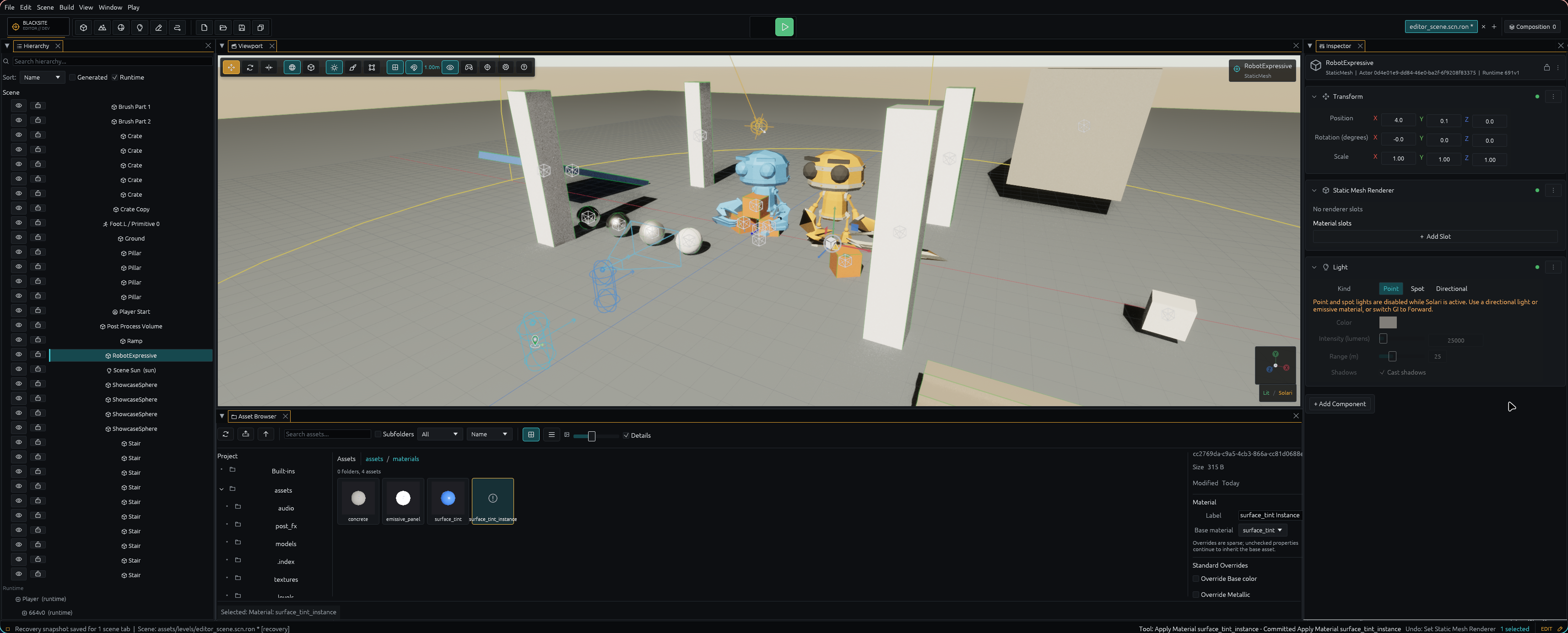
The actor combines renderer and light components without an ActorKind exclusivity rule. The
registry owns add/remove/reset/copy/paste/history/persistence behavior; ActorKind remains a
derived compatibility and presentation hint.
Larger material thumbnail previews
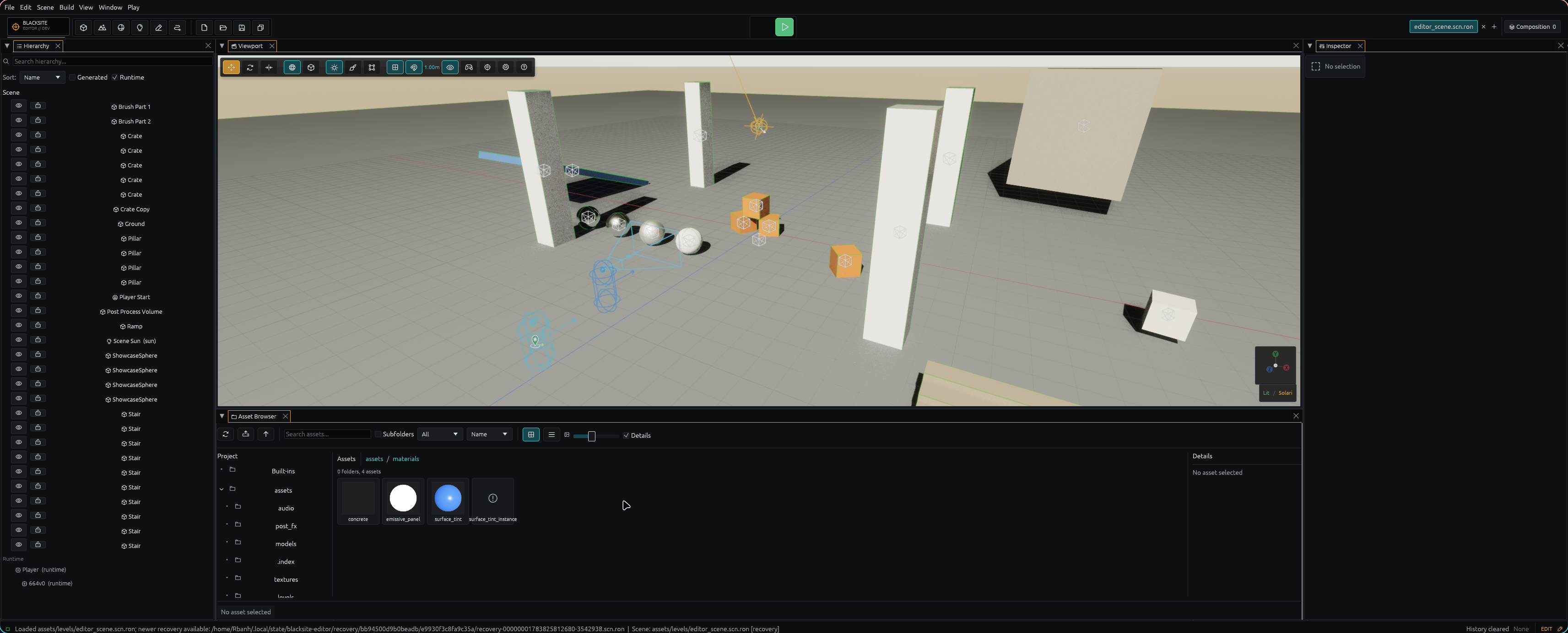
Material spheres now fill roughly 78-81% of the preview while retaining edge padding. Model and mesh-subasset framing is unchanged.
Additional captures:
Acceptance results
| Area | Result | Evidence |
|---|---|---|
| Dedicated static/skinned ownership | Pass | Separate authored/hydrated renderer types; rigged/animated manifests are rejected by static hydration |
| Pose lifecycle | Pass | Explicit stable default clip; transform and morph-weight baseline restore on stop, controller removal, preview reset, and PIE exit |
| Renderer material slots | Pass | Stable named IDs, imported fallback, explicit assignment, orphan retention, and in-place material patching |
| Material assets/instances | Pass | Versioned shared assets, direct-base sparse instances, Apply/Revert/Create Instance; property-block runtime application/promotion is isolated in #53 |
| Texture parameters | Pass | Project-wide picker includes imported texture subassets; base/schema/stored/instance slots share browse, drop, reject, and clear behavior |
| Component lifecycle | Pass | Stable registry IDs, reflected transactions/history, persistence allowlist, independent active state, and compatible composition |
| Surface raster/Solari semantics | Pass for eligible geometry | Shared ABI packing, evaluator, textures, normal/emissive/unlit values, and cutout predicate |
| Project migration | Pass | Transactional schema-v4 upgrader, backup/rollback path, canonical slots and active-state split; second dry run is empty |
| Project validation | Pass | 59 dependencies, 5 non-blocking findings, 0 blocking errors |
Automated verification
| Command/suite | Result |
|---|---|
cargo test -p shared --offline |
84 passed |
cargo test -p scene --offline |
64 passed, 1 ignored migration fixture |
cargo test -p game --lib --offline |
37 passed |
cargo test -p game_hot --lib --offline |
16 passed |
cargo test -p editor --lib --offline |
171 passed |
cargo test -p blacksite_surface --offline |
3 passed plus doc tests |
cargo test -p bevy_solari --lib --offline |
1 passed |
cargo --locked --offline validate-levels |
0 blocking errors |
cargo --offline upgrade-project --project . --json |
No pending changes or warnings |
cargo fmt --all -- --check / git diff --check |
Pass |
Deliberate boundary
Bevy 0.19's maintained Solari path does not expose dynamic post-morph/post-skin vertex buffers and BLAS updates. Skinned and morph-deformed actors therefore remain visible in raster but are omitted from ray tracing with an actionable diagnostic. This is safer than tracing a stale bind-pose ghost; dynamic deformed BLAS support is the independently scoped Gitea #54. Runtime property-block application and promotion are independently scoped in #53; this foundation record does not claim either follow-up.